On Sunday 4 August, the world eagerly waited for the Men’s 100 metre final to light up the Stade de France in Paris. Organisers were aware that this would be one of the highlights of the entire Olympics and so, not surprisingly, the event choreographers built as much anticipation as they could, through dramatic music, dimmed lights and, controversially, a period of extended waiting before the athletes took their marks.
But how long is too long? We saw athletes held for close to five minutes following their entrances. Many anxiously trying to keep their bodies moving, and minds focused on the race ahead. BBC commentators remarked on the extended wait and in a post-race analysis, Olympic Decathlon champion Denise Lewis worried about its unfair effect on the athletes. But was she right? Jessica Ennis-Hill rightly said that it didn’t appear to affect the times since it was one of the quickest races in history when considering all eight runners’ times.
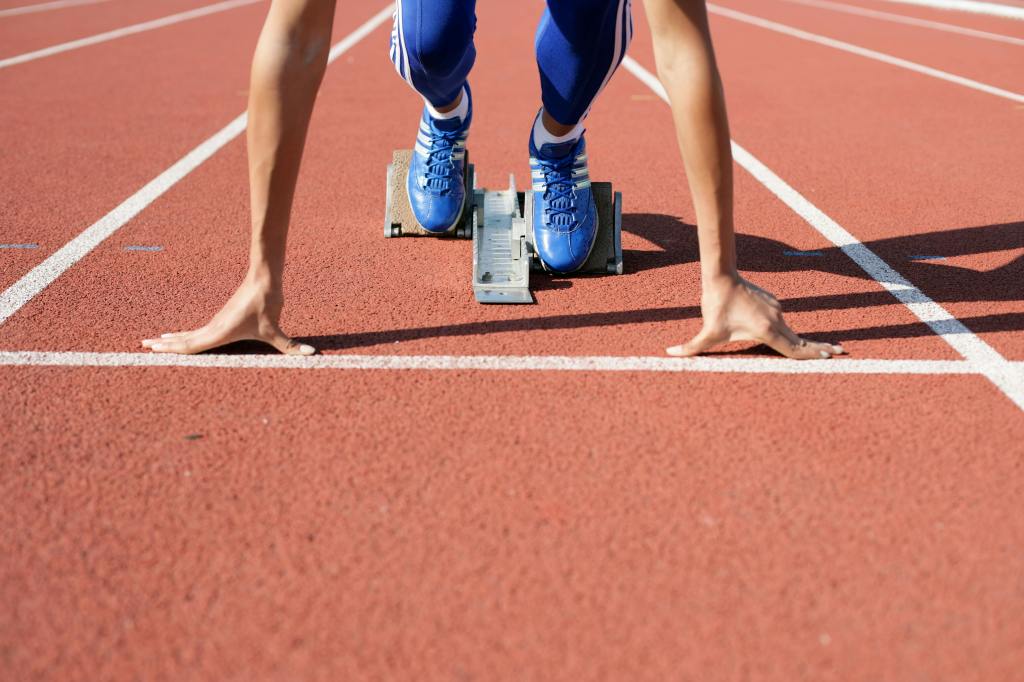
When athletes line up at the start line for any sprint, they face immense pressure and anticipation. Research in sport psychology suggests that prolonged delays in starting the race can significantly impact their performance.
“performance increases with arousal up to an optimal point”
One key concept is arousal regulation, explained by the Yerkes-Dodson Law, which argues that performance increases with arousal up to an optimal point. However, beyond this point, excessive arousal can lead to a decline in performance. Athletes waiting too long at the start line may experience heightened anxiety and arousal levels, pushing them past this optimal point. This can result in poor concentration, increased muscle tension, and erratic breathing, all of which are detrimental to sprint performance.
The concept of attentional focus is also critical. Athletes train to develop a narrow focus on the race and their technique. Extended waiting periods can disrupt this focus, causing athletes to shift their attention to external distractions or internal doubts. The unusually long waiting time would undoubtedly have come into the minds of each sprinter. According to the theory of attentional control, this shift can impair their ability to concentrate on crucial cues, like the starting signal, leading to slower reaction times and impaired performance.
Additionally, the psychological state of flow, often described as being “in the zone,” is crucial for peak performance. Flow requires a balance between challenge and skill, with minimal distractions. Prolonged delays can break this state, making it harder for athletes to re-enter the zone once the race starts.
So whilst extended waiting times at the start line can disrupt an athlete’s arousal levels, attentional focus, and flow state, all of which are essential for optimal sprint performance, the fact that we saw one of the quickest races in history suggests that each sprinter had the mental fortitude and resilience to ignore that long wait and remain focused on putting in a top performance.
For sport psychologists, this opens up the opportunity to develop this skill for their athletes, encouraging them to maintain the level of arousal for extended periods of time through practice and training.
 The Athletic Mind
Leave a comment