Last month, I was lucky enough to have some tickets for the Friday evening session at the World Athletics Championships in Tokyo. It was my first experience at an athletics meet and I was treated to some incredible performances, both physically and mentally. Femke Bol was dominant in the Women’s 400m Hurdles. Noah Lyles dealt with the huge public scrutiny and bounced back from his loss in the Men’s 100m final to win the Men’s 200m final emphatically. But it was the Men’s Triple Jump that really took me by surprise.
Pedro Pichardo’s triumph in the triple jump was a masterclass in composure, confidence, and clutch performance. Having led for most of the event and going into his final jump, the Portuguese athlete trailed his Italian competitor—a situation that often exposes even the most elite athletes to immense psychological pressure. Yet rather than tightening up or succumbing to anxiety, he produced his best performance when it mattered most. His ability to stay calm and perform optimally can be understood through the Theory of Challenge and Threat States in Athletes (TCTSA), a framework developed by Marc Jones and Carla Meijen (and colleagues) in 2009 to explain why some athletes thrive under pressure while others falter.
According to the TCTSA, how athletes interpret high-pressure situations determines whether they enter a challenge state or a threat state. Both involve some heightened arousal and physiological activation, but the key difference lies in perception. In a challenge state, the athlete believes they have the resources—skills, confidence, and control—to meet the demands of the situation. This mindset leads to efficient cardiovascular responses, better focus, and more effective decision-making. In contrast, a threat state arises when the demands seem to outweigh available resources, often resulting in tension, narrowed attention, and performance decline.
Pichardo’s final jump exemplified a challenge state. Instead of perceiving his position as one of desperation, he appeared to view it as an opportunity—to demonstrate mastery, to trust his preparation, and to execute under pressure. His composed body language and deliberate routine between jumps (certainly compared to the Cuban athlete that finished in third, who ran through on his last jump) suggested confidence in his technical ability and physical readiness.
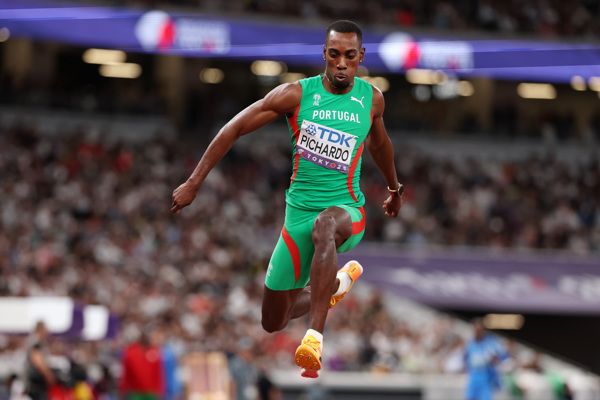
Importantly, Pichardo’s mental strength likely stems from extensive psychological preparation and experience. He is now a two-time World Champion after all. Elite performers often use techniques such as self-talk, pre-performance routines, and imagery to maintain a challenge-oriented mindset. By focusing on controllable elements—his approach rhythm, takeoff timing, and body alignment—Pichardo may have reduced the overwhelming nature of the moment to a series of manageable actions.
His performance reinforces a vital lesson from sport psychology: pressure itself is neutral; it is the athlete’s interpretation that defines its impact. Pedro Pichardo’s golden jump wasn’t just a feat of athleticism—it was a vivid demonstration of the challenge state in action, where confidence, control, and composure converged to bring home a World Championship.
 The Athletic Mind
Leave a comment